

On this page
For a long time, Quartz, also known as Quartz Scheduler, was the only viable open source task scheduler in Java. In fact, the official Quartz FAQ still states that there are “no known competing open source projects”. In this article, we will list a few different Quartz Scheduler alternatives that offer a similar set of features while being easier and more enjoyable to use.
Only interested in JobRunr versus Quartz? Read our JobRunr vs Quartz benchmark on Postgres for the head-to-head numbers, and how to move from Quartz to JobRunr for a step-by-step migration.
The Quartz Scheduler: how good is it really?
Similar to its alternative, the Quartz Scheduler can be integrated into almost any Java application to schedule and process any task implemented in Java. In its decades of existence, Quartz has evolved into a feature-rich framework for persisting task states, handling misfires and re-firing failed tasks, defining complex schedules, prioritizing tasks, achieving distributed processing, and more.
The fact that Quartz has been around for so long has two major advantages: the library is battle-tested and has a large community, which makes it easier to find help. All these elements together make it the most popular job scheduling library in Java. Despite all these strengths, choosing Quartz is no longer so obvious due to some glaring issues.
Limitations of Quartz
Quartz is showing its age
The Quartz scheduler has several issues that make it less of an obvious choice, especially when there are several really good alternatives.
The age of Quartz, while an advantage, is also a disadvantage, as the Quartz API and architecture are also getting older. The Quartz API can be considered verbose by today’s standards: every task needs a Job class, a JobDetail and a Trigger before it can run. This may not seem like a big deal, but it’s important for a library or language to remain attractive to the next generation of developers. Reduced verbosity is one of the main factors contributing to the popularity of Kotlin, and Java itself is moving toward becoming more beginner-friendly.
Another place where Quartz shows its age is in its architecture. When using an RDBMS, the scheduler requires the creation of 11 tables, which is probably overkill for most applications where the actual business logic requires fewer tables.
We have written an article that explains why some people move from Quartz to JobRunr and how to do so.. This article gives a feel for how complex and verbose Quartz is to use.
Performs worse than modern alternatives
When compared to more modern alternatives, Quartz is reported as having significantly lower performance. This performance issue may be caused by the use of row level lock and the complexity of the configuration making the Quartz Scheduler harder to fine-tune.
We measured it ourselves: on the same hardware and the same Postgres database, Quartz processed 145 jobs per second where JobRunr Pro processed 2,732 jobs per second, roughly 18 times more. The setup, the code and the raw numbers are in our JobRunr vs Quartz benchmark.
Lack of built-in monitoring
Quartz Scheduler lacks an intuitive dashboard or UI for tracking and monitoring jobs. It also doesn’t provide a way to interface with external monitoring tools like Grafana or Jaeger. Quartz users cannot actively monitor the system to proactively address issues such as job failures.
The Spring Boot Actuator quartz endpoint lists jobs and triggers as JSON, but that is still not a view of what ran, what failed and why.
Distributed scheduling is opt-in
Quartz has the ability to handle the tasks in a distributed fashion, but this feature is opt-in: you need the JDBC job store with org.quartz.jobStore.isClustered=true on every node. With tools like Kubernetes now allowing a pod to spin up on demand, such a feature should not be an afterthought, but rather the default.
Sporadic maintenance
Quartz went five years without a stable release, from 2.3.2 in October 2019 to 2.4.0 in November 2024. While development was on hold, the ecosystem around it didn’t stop evolving, and users were stuck on the javax namespace while the rest of the Java world moved to jakarta. Quartz now ships two release lines, 2.4.x for Java 8 and javax and 2.5.x for jakarta and Java 11, but the pace is slow, with a few bug-fix releases a year.
Quartz users also cannot use newest Java features such as virtual threads, that may benefit background job processing, for instance to increase throughput. The GitHub issue asking for virtual thread support is open, and the main branch would first need to move from Java 11 to Java 21.
Quartz belongs to IBM, and the change of ownership brought a spark in activity, with the community helping to fix major issues such as the
jakartamigration. It is still unclear what this means for the long-term future of Quartz.
Modern alternatives to Quartz Scheduler
If you’re looking for a Quartz alternative for your Java application, there are several modern open source schedulers that offer similar features, more developer-friendly APIs, and more robust support for distributed and cloud-based environments.
We distinguish between two types of schedulers:
- The first class consists of Java job scheduling libraries. Similar to Quartz, they can be included in any Java application. They live inside your application.
- The second class are workflow engines, which target a broader audience. These are standalone services that your application will need to communicate with.
Here is a quick overview before we go into each one:
| Type | Storage | Monitoring UI | License | |
|---|---|---|---|---|
| Quartz | Java library | 11 tables in your RDBMS, or in memory | None built in | Apache 2.0 |
| JobRunr | Java library | Your SQL database or MongoDB, or in memory | Built-in dashboard | LGPL v3 (Pro is commercial) |
| db-scheduler | Java library | One table in your relational database | Community add-on (db-scheduler-ui) | Apache 2.0 |
Spring @Scheduled + ShedLock | Lock for in-memory scheduled tasks | A lock record (JDBC, MongoDB, Redis, …) | None | Apache 2.0 |
| Kestra | Standalone workflow platform | Kestra’s own backend | Built-in UI | Apache 2.0 (Enterprise is commercial) |
| Temporal | Standalone workflow engine | Temporal’s own persistence | Built-in Web UI | MIT (server), Apache 2.0 (Java SDK) |
Alternatives to Quartz in Java
There are two great alternatives to Quartz for scheduling jobs in Java, namely JobRunr and db-scheduler. They can be added as a dependency to any Java application. If you only need to stop a Spring @Scheduled task from running on every node at once, a lock such as ShedLock is a lighter option, with no job state, retries or dashboard. Our Java cron jobs guide compares @Scheduled, Quartz and JobRunr for recurring tasks.
These libraries keep the number of third-party dependencies to a minimum, providing better security insurance. They are available as standard Java jars on Maven Central.
JobRunr
JobRunr is a modern, actively maintained, open source Java library designed for background job processing. JobRunr offers an easy-to-use API that simplifies job scheduling. Unlike Quartz, JobRunr was designed with cloud-native applications in mind and provides support for distributed job scheduling.
JobRunr aims to be developer friendly by providing a simple, flexible and straightforward API, automatic retries on failure, and seamless integration with your existing infrastructure. In fact, all you need to create a background job is a Java lambda. JobRunr also supports all major SQL databases and popular NoSQL databases.
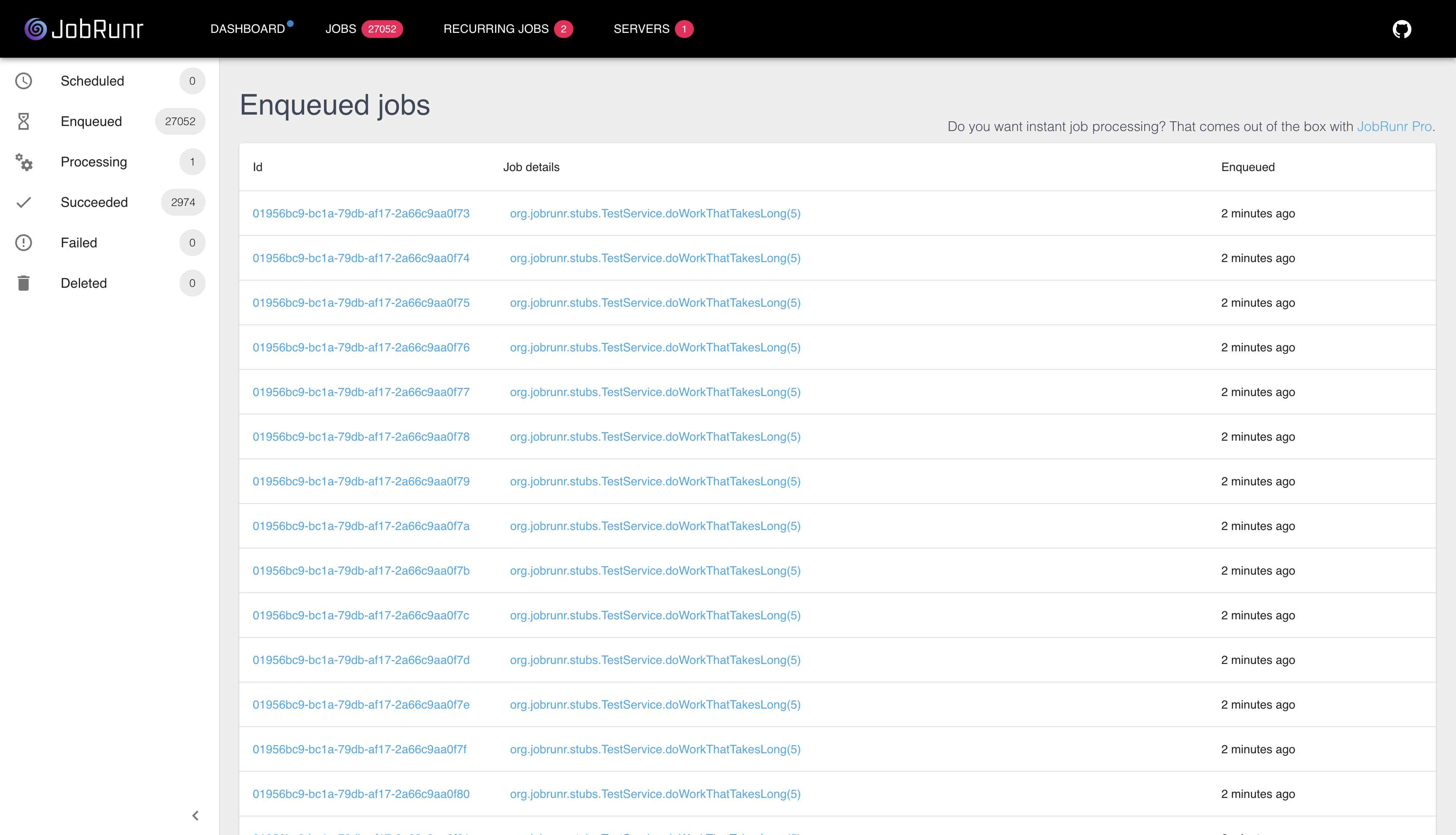
A feature of JobRunr that neither Quartz nor db-scheduler provide out of the box is a dashboard. Thanks to the built-in dashboard, its easy to monitor the system to see why a job failed or to perform actions such as requeuing or deleting a job.
Used and trusted by industry leaders, the open source version of JobRunr provides the essential features you need to schedule tasks in Java. You can expect features similar to those in the Quartz Scheduler, but much easier to use. The JobRunr team also develop and maintain JobRunr Pro which offers Enterprise grade features, making JobRunr Pro the best job scheduling library in Java!
A few things you will not find in Quartz:
- Virtual threads. On JDK 21 and later, JobRunr runs your jobs on virtual threads by default, which gives significantly higher throughput for I/O bound jobs. Our post on Java job threading options explains when they help and when they hurt.
- Durable jobs. Wrap each step of a job in
jobContext.runStepOnce("charge-card", () -> ...)and a retry skips every step that already completed, so a failing email server does not charge the customer twice. Keep the side effect inside a step idempotent, and read the durable executions guide for the details. - A job history Chart. The dashboard draws every attempt of a job, down to the individual durable steps, so you see which step failed and which steps were skipped on the retry.
- Starters for Spring Boot 3 and 4, Quarkus and Micronaut, so JobRunr follows the framework upgrades you are doing anyway.
Get started with JobRunr | See how JobRunr compares to Quartz | Move from Quartz to JobRunr | Watch Ronald present JobRunr at Spring I/O 2022
DB Scheduler
Another good alternative to Quartz is db-scheduler. The library was originally designed to be a simpler alternative to Quartz. This design reduces the number of required tables to one (a single scheduled_tasks table, compared to Quartz’s 11 tables!) and provides a much simpler API.
Similar to JobRunr, db-scheduler is distributed by default and guarantees that the same job will not be run concurrently. This guarantee is achieved by using the same centralized DB; in the case of db-scheduler, a relational database is required.
DB Scheduler provides all the essential features for background job scheduling, it can handle fire-and-forget jobs as well as scheduled (a.k.a. delayed) and recurring jobs. The library provides some simple monitoring via Micrometer. It can also perform an automatic retry if a task fails, with exponential back-off configured through a FailureHandler.
The library is well maintained and growing in features to match the capabilities of Quartz Scheduler, without the extra complexity. It requires Java 17 or later and ships a Spring Boot starter. There is no dashboard in the project itself, but the community-built db-scheduler-ui gives you a basic admin UI you add separately.
Other job scheduling tools
There are several job scheduling alternatives to Quartz that are aimed at a broader audience; we could probably not list them all, even if we wanted to. These alternatives come as standalone services, often referred to as workflow engines, that communicates with your application.
Using these tools means you’ll have to get used to the terminology they use. In particular, you’ll have to accept that every task, even the simplest, must be defined as a workflow.
Here we’ll briefly introduce two such workflow engines that work well with Java applications: Kestra and Temporal.
Kestra
Kestra is an open-source workflow automation platform that makes job scheduling easy. The engine is written in Java, but tasks can run in any programming language. Kestra is a great low-code alternative to Quartz: workflows are declared in YAML rather than assembled in code, and a plugin catalogue of 2,400+ integrations lets you read from any database, cloud storage or API, and run scripts in any language.
Kestra provides a UI for writing or configuring workflows. This UI can also be used to monitor the system and track workflow state changes.
Kestra also has all the essential features required for job scheduling: reliable distributed system, retries, delayed and recurring executions. On top of that it can trigger workflows on events rather than time alone, such as a file landing in object storage, a message on a queue, or a webhook. That, together with the ability to orchestrate work outside the JVM, is the main reason to reach for a workflow engine instead of an in-application scheduler. The open source edition is Apache 2.0 licensed; SSO, RBAC and multi-tenancy are part of the commercial Enterprise edition.
Temporal
Temporal is an open source workflow engine designed to make applications more resilient. The engine is written in Go and can be interfaced with your Java application using the provided Java SDK.
Very similar to pure Java-based solutions like JobRunr or Quartz, Temporal provides the essential features that help developers to focus on business logic instead of worrying about the complex mechanisms behind a resilient and distributed scheduler.
In addition to providing features such as retries, scalability, delayed and recurring executions, Temporal also provides a user interface that allows you to monitor workflow execution to detect failed tasks.
Temporal shines for long-running workflows that wait for days on a timer or a human approval. The price is a separate cluster to run and a programming model with its own rules. If your durable work fits inside a single job with a few steps, runStepOnce in JobRunr gives you the same step-level guarantee without that extra infrastructure.
Conclusion
For a long time, there was no real alternative to Quartz for job scheduling in Java. This is no longer the case, as there are several modern tools available to developers. These tools are simpler to use while providing the essential building blocks to achieve reliable and distributed scheduling.
You may be looking for a persistent task scheduling library that integrates seamlessly into a Java application. In this case, we highly recommend trying out our solution JobRunr. DB Scheduler is another option that can give you satisfactory results. If all you need is to keep a Spring @Scheduled task from running on every node, ShedLock is the smallest step.
You can also take a look at workflow engines such as Kestra or Temporal. These are especially useful if your tasks are written in different programming languages, are triggered by events outside your application, or run as long-lived workflows.
Quartz itself is still maintained, so staying on it is a valid choice for a stable application that works today. For new code, or when you hit its limits on monitoring, throughput or virtual threads, it is worth comparing.
With these diverse tools at their disposal, Java developers can now select the one that best meets their needs, rather than relying on a single option. If JobRunr is on your shortlist, read the Quartz to JobRunr migration guide next.